The situation
Illustrative example. Not a real job or customer.
In an invented 1980s two-story house, the owners notice a yellowish stain on the dining room ceiling, directly under the upstairs hall bathroom. It is dry to the touch. The house still has its original gray plastic supply pipe. Nobody remembers a spill or overflow.
- The owners photograph the stain and run a meter test: with every fixture off, the water meter's small dial turns slowly.
- A plumber finds a damp area inside the vanity cabinet and opens the drywall behind it, revealing a crimp fitting on the cold line seeping a steady drip.
- The plumber cuts out the fitting, installs a temporary repair and saves the failed piece in a bag.
- A restoration contractor maps moisture: the vanity floor, subfloor around it and a joist bay above the dining room read wet.
- The dining room ceiling is opened in one bay, wet insulation removed and the cavity dried with directed air and a dehumidifier.
- With walls and ceilings already open, the owners decide to re-pipe the house before patching.
Drying took several days. The re-pipe used the existing openings plus a handful of new ones, and all drywall was patched, textured and painted in one pass afterward.
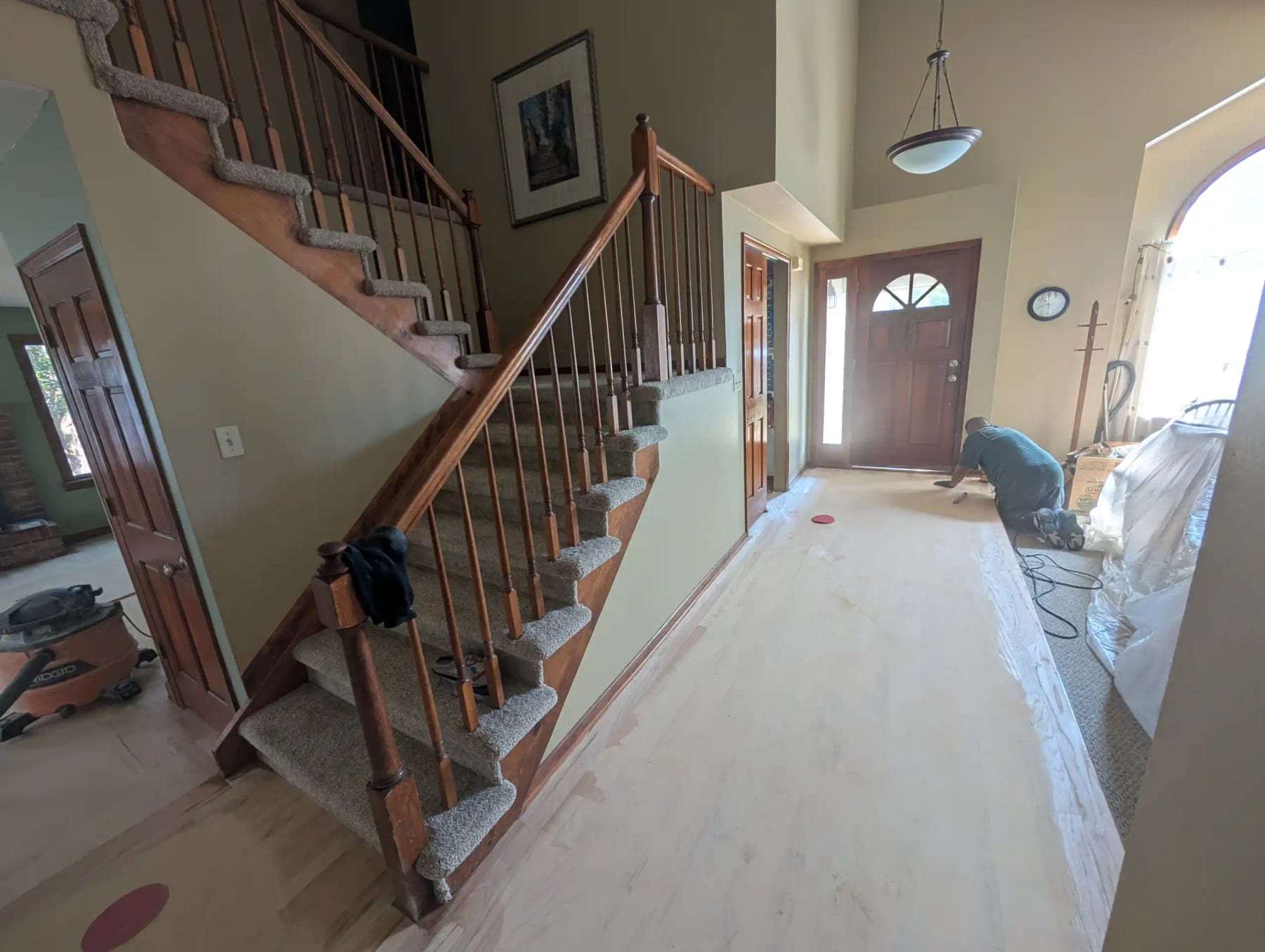
Entry hall with the flooring removed down to the subfloor and the stair protected. Included to show the kind of work involved, not a property or job connected to this site.
What went right and what could have gone wrong
Helped
- A meter test confirmed an active leak before anyone guessed
- The failed fitting was saved for the adjuster
- Drying covered the cavity, not just the visible stain
- Re-pipe was decided before drywall closed
Common missteps avoided
- Painting the stain because it felt dry
- Replacing only the fitting and closing the wall without readings
- Patching the ceiling, then reopening it for the re-pipe
- Throwing out the failed part
Decision points along the way
- IfStain is dry but meter movesThenTreat it as an active leak and locate it, even though nothing looks wet.
- IfOnly one fitting failedThenWeigh a single repair against a full re-pipe while walls are open.
- IfInsurance covers resulting damage but not new pipeThenSeparate the two scopes clearly so each invoice is easy to follow.
Lessons that carry over
- A dry stain can still be part of an active leak
- Learn to read your water meter before you need to
- Ask for readings on the floor system, not only the wall
- Coordinate plumbing and drywall so each surface is opened and closed once
Common questions
- Did insurance pay for the re-pipe?
- In this invented example, the policy covered the resulting water damage and the drying, while the owners paid for the new piping. That split is common, but the real answer always depends on the policy and the adjuster.
General information for Highlands Ranch, not a quote or professional advice. In an emergency, call 911.